

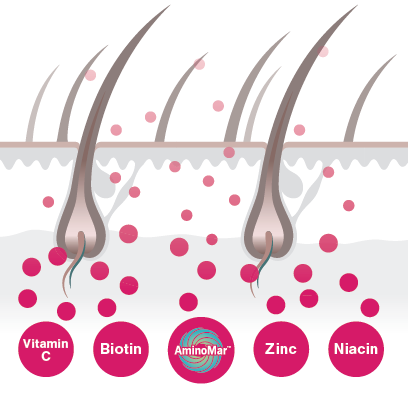


Four Stages to Healthier Hair
Viviscal® works in 4 stages over 6 months (although most users notice a difference after just 3 or 4 months – in line with the natural hair growth cycle).
STAGE 1 – Nourishes the hair follicles.
STAGE 2 – Strengthens and promotes the growth of existing hair.
STAGE 3 – Promotes the growth of existing hair where it has slowed down or
temporarily stopped. These hairs are thin and wispy at first.
STAGE 4 – Hair becomes stronger, healthier and more vibrant.
Viviscal® on Dateline NBC, The Follicle Five: Battle Against Baldness
November 2004
“Hector R., 38 is married with two children and works for IBM in computer tech support. His job requires taking a lot of training classes, but his learning often takes a back seat to his hair. He would try to sit in the back of the class or the back of elevators so he doesn’t have to worry about people staring at his balding head. And he hopes his wife will be understanding about his taking on this Dateline hair challenge.”
After six months :
“Hector, our computer support technician is taking Viviscal®, the fish-based product imported from Finland. He had said his expectations were low [before the project started].
Hector feels he has had some success, because his hair has stopped falling out. It also has stopped drying out.
Hector: "I think it's worth it. If it helps you maintain what you have, I think it's definitely worth it."
The company that makes Viviscal® says people who are in the early stages of hair loss "are likely to benefit most" from using their product. Hector has been losing his hair for more than 10 years. “
Viviscal Studies
Treatment of Alopecia Areata, Alopecia Totalis and Alopecia Universalis with Oral Viviscal® for 12 months
Swedish Alopecia Association, administrated by B. Prästbacka (chairman) and Patricia Brosdotter-Johansson (vice chairman)
The study was clinically monitored by M. Majass (md) and O. Puuste (md)
Department of Dermatology, Central Hospital, Tallinn, Estonia, 1994
SUMMARY
Altogether 97 members of the Swedish Alopecia Association (RFH) with either alopecia areata, alopecia totalis or alopecia universalis volunteered to participate in a 12 months study to evaluate the effect of oral Viviscal® on regrowth of scalp hair. Thirteen patients withdrew after 3 - 4 months because of lack of effect of the treatment. The remaining 84 patients fulfilled the treatment and were therefore evaluable. Fifty of these had alopecia areata, 12 alopecia totalis and 22 alopecia universalis. They all took two tablets of Viviscal® daily for 12 months. Before the study, after 6 and 12 months they fulfilled a questionnaire regarding the start of regrowth of scalp hair and the estimated area of the scalp with regrowth of permanent hair. In the areata group regrowth of permanent hair started to appear after approximately 6 months in 46 patients, in the totalis group in 10 patients after 4 months and in the universalis group after 5 months in 7 patients. After 12 months 7 patients in the areata group (14%) showed complete regrowth of hair, 27 patients estimated a regrowth of 70 - 95%, 10 a regrowth of 50 - 65% and 6 a regrowth less than 50%. In the totalis group 3 patients had a complete hair regrowth, 3 a regrowth of 70 - 95%, 4 a regrowth of 50 - 65% and 3 a regrowth of hair less than 50%. In the alopecia universalis group one of the patients reported complete regrowth of hair, 4 had a regrowth of 70 -95% and one a regrowth of 50 - 65%, while 16 had less than 50% regrowth of scalp hair. Better nail growth was reported by all patients with weak nails prior to the study. Overall 34 patients (68%) of the patients in the alopecia areata group, 6 of the patients (50%) of the patients in the alopecia totalis group and 5 patients (23%) in the alopecia universalis group were highly satisfied with the treatment results, while 10 (20%), 4 (33%) and 1 (5%), respectively estimated the end result as good. There was a significant correlation between the treatment results and the type of alopecia, but no significant correlation between the sex and age of the patients or duration of hair loss could be observed. No adverse reactions or unexpected events were reported by the patients.
Treatment of Alopecia Areata and Alopecia Totalis With Viviscal® (Special Marine Extract Compound)
A. Lassus, J. Santalahti, M. Sellmann
Helsinki Research Center, Helsinki, Finland
Dermatological Clinic, Leverkusen, Germany, 1993
SUMMARY
Twenty patients with alopecia areata (mean duration 9 years) and 20 patients with alopecia totalis (mean duration of 7 years) were treated with 2 pills of Viviscal® Liniment once daily and Viviscal® shampoo 2-3 times/week for eight months. Viviscal® is a preparation containing mainly compound of marine extract and colloidal silicic acid. Both group included 10 females and 10 males. All patients had earlier received topical steroids and 15 had had been treated with systemical corricosteroids. Most of them had also been treated with topical minoxidil and photochemotherapy. Seventeen of the patients with alopecia areata (85%) were completely cured and two showed significant improvement. One of the patients in this group deteriorated during the treatment period. Five (25%) of the patients with alopecia totalis were completely cured and four (20%) showed significant improvement, while 11 patients developed only minimal vellus hair. This promising study showed that Viviscal® is a further complement to the rather short list of remedies which alter the clinical course of alopecia areata and alopecia totalis.
A Comparative Study of a New Food Supplement, Viviscal®, with Fish Extract for the Treatment of Hereditary Androgenic Alopecia
A. Lassus et. al.
Department for Dermatological Research, ARS-Medicina, Helsinki, Finland
The Journal of International Medical Research 1992; 20: 445-453
SUMMARY
A controlled, randomized, double-blind, parallel-group study compared the effects of Viviscal® (a new food supplement incorporating special marine extracts and a silica compound) with those of a fish extract in the treatment of young males with hereditary androgenic alopecia. The pretreatment histological diagnosis was alopecia with a mild to moderate perifollicular inflammation zone. The study consisted of 20 subjects who received two tablets of Viviscal® once daily and 20 who received two tablets of fish extract once daily for 6 months. The mean patient age and mean duration and severity of baldness compared well between the two groups. Most patients had been treated with long-term topical 2% minoxidil for 1 year or more prior to the study. At baseline and after 6 months' treatment, a biopsy was taken for histological examination. A non-vellus hair count was performed at baseline and after 2, 4 and 6 months. In the fish extract treatment group three patients withdrew from the study before the fourth month due to lack of therapeutic effect. After 6 months' treatment, patients receiving Viviscal® showed a mean increase in non-vellus hair of 38% compared with a 2% increase in the fish extract treatment group (P<0.0001). In the Viviscal® group, 19 (95%) subjects showed both clinical and histological cure, whereas none treated with fish extract showed any clinical or histological difference after 6 months' treatment (P <0.0001). In both groups, a minimal decrease in the erythemal index was observed. In conclusion, Viviscal® appears to be the first highly active treatment for androgenic alopecia in young males.
For complete information on our scientific studies, please contact Lifes2good at information@lifes2good.com
Hair Loss The Facts
The Hair Growth Cycle
We're born with all our hair follicles already in place. While some may change in size over time, we don't develop any new ones after birth. As adults, we have about 100,000 individual strands of hair. It's completely normal to lose some 40 to 100 strands every day. Normal hair loss is the result of the growth cycle of the follicles, similar to an 'on off' system. This means that when an old hair 'dies', the growing phase starts again for a new hair to replace it. The hair growth cycle has three different phases:

1. Anagen
The Anagen phase is the growing phase or the 'on' phase, which lasts for an average of approximately 1,000 days in the human scalp, but can range from 2 - 6 years. During the Anagen phase, hair cells proliferate rapidly. The hair shaft grows in diameter and the hair reaches maximum length.
2. Catagen
The Catagen phase lasts only 1 - 2 weeks - it's the transitional or regressive phase before the resting phase begins. It's essentially when the hair stops growing.

3. Telogen
The Telogen phase is the final resting stage or 'off' phase, which lasts for about 5 - 6 weeks.
When the old hair is in the Telogen phase, activity in the hair follicle is renewed. A new hair in the Anagen phase develops and forces the old Telogen hair out. This is when hairs are lost and you might notice them in the bath or in your brush or comb.
As mentioned, on average 40-100 hairs are lost due to this natural growth process every day. This is normal hair loss and accounts for the hair loss seen every day in the shower and with hair combing. In healthy follicles these hairs will soon be replaced by new hair.
A variety of factors can alter the normal hair growth cycle and cause temporary or permanent hair loss including medication, radiation, chemotherapy, exposure to chemicals, hormonal and nutritional factors, thyroid disease, generalized or local skin disease, and stress.
You can read more about the causes of hair loss in our Types of Hair Loss section.
Facts about Hair and Hair Loss
-
The average person has 100,000 - 150,000 hairs on their head
-
One hair fiber can support the weight of 100 grams
-
The main component of hair is the keratin, which also holds the responsibility for the elasticity of the finger nails
-
Hair is the second fastest growing tissue in the body (bone marrow is quicker). A hair grows 0.3-0.5mm per day
-
In any given time, about 10% of the hairs are resting and the rest are growing
-
Everyone loses more than 40% of his/her hairs - about 100 hairs a day
-
Hair loss will be visible only after losing more than 50% of hair
-
More than 50% of men above the age of 50 suffer from hair loss
-
Between a third and two thirds of all women experience thinning hair or hair loss at some stage in their life
-
The most common form of hair loss in women is Effluviums (all over thinning of hair)
-
Common reasons for hair loss include: postnatal, menopause, HRT, The Pill, stress, diet and trauma
-
Great looking hair makes you feel good - it also attracts the attention of the opposite sex.
It is part of our personality
-
Hair gives us key information about a potential mate's health. Healthy hair tends to mean a healthy person
Myths Related to Hair Loss
The following are some common myths about hair loss people tend to believe. These are false!
· Frequent shampooing contributes to hair loss.
· Hats and wigs cause hair loss.
· 100 strokes of the hair brush daily will create healthier hair.
· Permanent hair loss is caused by perms, colors and other cosmetic treatments.
· Shaving one's head will cause the hair to grow back thicker.
· Standing on one's head will cause increased circulation and thereby stimulate hair growth!
· Dandruff causes permanent hair loss.
· Hair loss does not occur in the late teens or early twenties.
Types of Hair Loss
Alopecia Areata
Alopecia Areata is thought to be an auto-immune disease of the hair, this means that the body's immune system acts as if the hair follicles are foreign and attacks them. White blood cells called T- lymphocytes attack the hair follicle which causes the hair to stop growing and enter into the telogen (resting) phase, then about 3 months later, when the resting phase is over, the hair will then fall out. Only when T-lymphocytes stop attacking the hair follicle will new hair grow.
Alopecia Areata initially appears as a rounded bare patch about an inch across. It affects both men and women equally and is often experienced first in childhood. According to a survey taken in America, one person in every hundred is likely to experience Alopecia Areata at sometime in their life. Many people affected with Alopecia Areata will only have one experience of hair loss with re-growth occurring afterwards, however it is estimated that in approximately 20 percent of cases, hair loss recurs or becomes permanent.
There are three types of Alopecia Areata, which are named according to their severity. These are as follows:
Alopecia Areata; mild patchy hair loss on the scalp Alopecia Totalis; loss of all scalp hair Alopecia Universalis; loss of scalp and all body hair
Studies have shown that Viviscal® proves effective in the treatment of all three types of Alopecia. See our clinical trials section for more information.
Self Induced Hair Loss
Some damage to the hair is self-inflicted sometimes consciously or unconsciously. The two main types of self-induced hair loss are Trichotillomania and Traction Alopecia.
Trichotillomania
Trichotillomania is self-induced hair loss, which results from the continuous pulling or plucking of the hair. It occurs most commonly among young children, adolescents and women and affects twice as many females as males. The hair is often pulled out in distinct patches on the scalp however, some individuals also pull out eyebrows and eyelashes.
The treatment for Trichotillomania often involves counseling or psychiatric help, however in some cases an antidepressant may be prescribed.
Traction Alopecia
Traction Alopecia is usually caused by continuous and excessive pulling on the hair due to various types of hairstyling. Ponytails, buns, braiding and cornrows often result in a continuous pulling on the hair. This traction gradually results in hair loss. If this type of traction and hair loss continues for an excessively long period of time then the hair loss may become permanent. Generally however a change in hairstyle that reduces the traction on the hair and hair follicle is all that is required in the treatment of Traction Alopecia.
Androgenetic Alopecia
Hair loss resulting in thinning is known as alopecia. When it is related to hormones (androgens) and genetics, it is known as androgenetic alopecia, or more commonly just balding. Male pattern alopecia is characterized by a receding hairline and/or hair loss on the top of the head. A similar type of hair loss in women, female pattern alopecia, results in thinning hair on the vertex (top) of the scalp but is generally less severe than occurs in males. The Norwood-Hamilton Scale (Fig 1.) shows the progressive stages of male pattern hair loss. Left untreated, male pattern hair loss is a condition that usually gets worse.
Fig 1. Norwood Hamilton Scale

Studies have shown that Viviscal® proves effective in the treatment of Androgenetic Alopecia.
Telogen Effluvium
Telogen effluvium occurs when sudden or severe stress causes an increase in the shedding of the hair. With telogen effluvium, a sudden or stressful event can cause the hair follicles to prematurely stop growing and enter into a resting phase. The hair will then stay in the resting phase for about 3 months after which time a large amount of hair will be shed. Often the person involved will have recovered from the event before the hair loss occurs. In most cases the hair loss is temporary and the hair soon recovers. However in some cases the hair loss continues until the underlying cause is fixed. Telogen effluvium appears to affect more woman than men because more of the precipitating events such as childbirth are experienced by women.
Telogen Effluvium can be caused by the following:
Hormonal changes
Infections of the scalp
Major Surgery/Chronic Illness
Severe psychological stress
Crash diets/inadequate protein
Drugs/Medication
Hair Loss resulting from Thyroid Gland malfunction:
Generally the first test a doctor or specialist is likely to carry out on a patient who is experiencing hair loss is a thyroid function test, as a thyroid problem may result in hair loss. Two types of thyroid problems can occur and either of these problems can result in hair loss. These conditions are Hypothyroidism (the under production of Thyroxine) and Hyperthyroidism (the over production of Thyroxine).
Hair loss may occur from either hypothyroidism or hyperthyroidism. In some cases hair loss is minimal, however some individuals experience severe hair loss. Fortunately hair loss is usually reversible with proper treatment. If you suspect that you have a problem with your thyroid function then you should visit your doctor.
Infections of the scalp:
Infections such as ringworm can invade the hair and skin of your scalp, leading to hair loss. Once infections are treated, hair generally re-grows.
Major Surgery/Chronic Illness:
The shock involved in a major operation can result in sudden hair loss. Also after micro graft and mini graft surgery where follicles are transplanted on the scalp telogen effluvium almost always occurs. Due to the shock of surgery the hair follicles will fall out within about 3 months after which time new hairs will grow from the transplanted follicles.
Some cancer treatments will cause hair cells to stop dividing. Hairs become thin and break off as they exit the scalp. This occurs one to three weeks after the treatment. Patients can lose up to 90 percent of their scalp hair. The hair will re-grow after treatment ends.
Severe Physiological Stress:
Some people experience telogen effluvium or sudden diffuse hair loss after a traumatic event such as the death of a family member or someone close, an accident, abuse or any other severely traumatic event. These events may trigger hair follicles to enter the resting phase prematurely in which case an increase in the amount of hair shed will be noticed about 3 months after the event. When the stressful situation is over or the body adjusts to it, the hair usually grows back.
Crash Diets/Inadequate Protein:
Some people who go on crash diets that are low in protein, or have severely abnormal eating habits, may develop protein malnutrition. The body will save protein by shifting growing hairs into the resting phase. Massive hair shedding can occur two to three months later. Hair can then be pulled out by the roots fairly easily. This condition can be reversed and prevented by eating the proper amount of protein and, when dieting, maintaining adequate protein intake.
Drugs/Medication:
Some prescription drugs may cause temporary hair shedding. Examples include some of the medicines used for the following: gout, arthritis, depression, heart problems, high blood pressure, or blood thinner. High doses of vitamin A may also cause hair shedding.
The following is list of some drugs that have been reported to have a side effect of hair loss:
Alloppurinol (for the treatment of Gout)
Heparin (blood thinner)
Coumarin (blood thinner)
Clofibrate (Cholesterol lowering drug)
Gemfibrozil (Cholesterol lowering drug)
The above drugs are only a few of the drugs that have been reported as contributing towards hair loss. If you suspect that prescription drugs that you are taking are causing hair loss you should discuss this with your doctor.